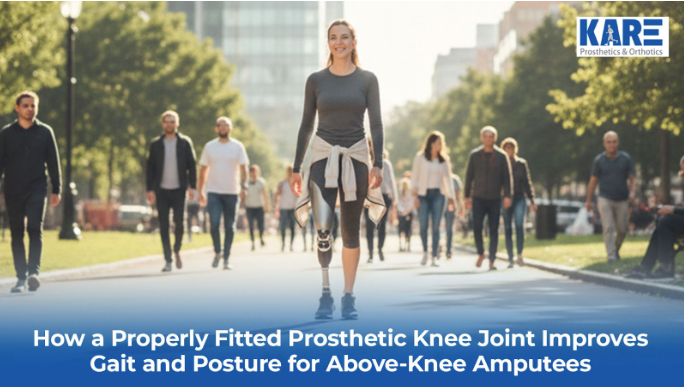
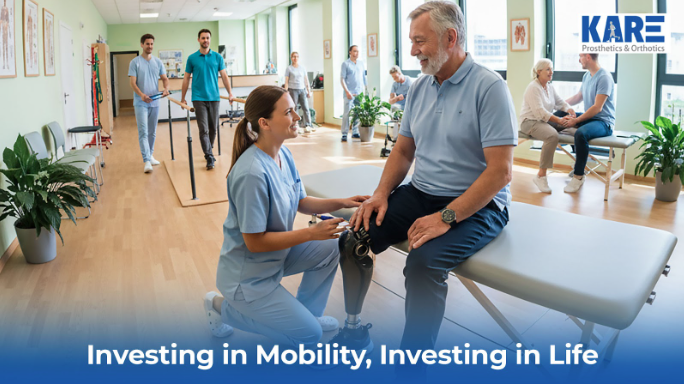
Being an above-knee amputee is a challenge. Without the appropriate support, walking and standing upright will be unnatural, and posture will be compromised. Nonetheless, with an above-knee prosthetic knee joint well-fitted to your artificial leg, many amputees can move more smoothly, with a better sense of balance and greater confidence in their day-to-day lives. In this post, we discuss why proper fitting is essential and how it can improve posture and gait, in straightforward, easy-to-understand terms.
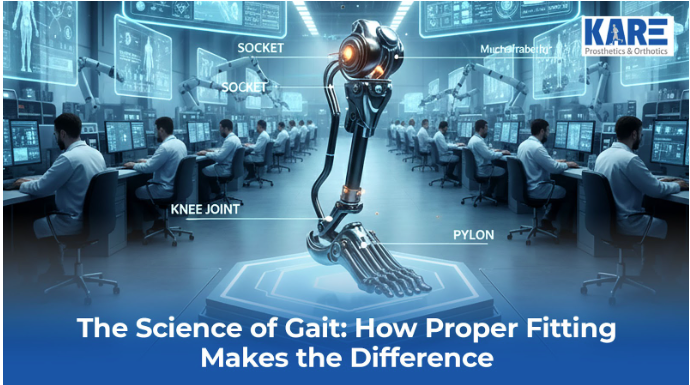
How a Good Prosthetic Knee Joint Helps: Key Benefits
-
Improved Gait and More Natural Walking
Modern Prosthetic knee joints, when properly fitted, enable above-knee amputees to walk much more naturally. Research indicates that the use of a microprocessor-controlled prosthetic knee assists the user in transitioning from a stiff, hyperextended knee to a more natural flexed knee during walking. This results in balance and a more energy efficient natural gait.
Also, an improved level of prosthetic knee supports step length and timing between the sound leg and the prosthetic leg. This symmetry would reduce stress on the healthy leg and help prevent overuse injuries.
-
Better Balance, Stability and Confidence
A prosthetic knee joint that allows one to bear the weight properly, particularly when sitting up, rising, or walking on rough surfaces, makes amputees sit straight and assume a more suitable posture. The more stable and confident the user is, the more manageable tasks such as climbing stairs, walking up hills, or even standing up after sitting in a chair become.
This added stability also helps minimise the risk of falls or missteps, which is one of the biggest fears of above-knee amputees.
-
Reduced Fatigue and Lower Energy Cost
Using a prosthetic leg requires less power than walking. It has been demonstrated that gait asymmetry increases the metabolic cost considerably in above-knee amputees.
With a well-designed prosthetic knee and proper fitting and positioning, many users consume less energy. That is taking walks, staying active, and making the most of life without easily getting tired.
-
Protects Your Body — Healthier Long-Term Use
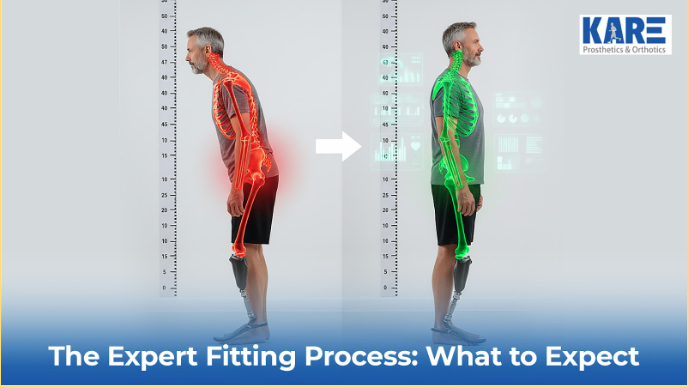
An artificial leg above knee and with an adequately installed prosthetic knee joint is expected to distribute the load evenly, eliminating the excessive pressure on the hips and spine, and the intact leg. This, in the long run, prevents the joint pain, back problems or premature degeneration of the sound leg.
Besides, providing the user with the best mobility and balance helps them remain active, which is critical to overall physical health, mental well-being, and quality of life.
What Happens Without a Proper Fit
The effects of using a prosthesis that is not aligned or appropriately fitted are most likely to cause:
- Asymmetrical walking – irregularity in step count, limping or asymmetric weight distribution.
- Higher energy consumption – walking becomes tiring sooner, as the organism must exert more effort to stand on its feet and correct its weak posture.
- Postural problems – impaired gait can cause pelvic tilt, back soreness, or overuse of the healthy leg and joints, leading to long-term problems.
The Role of Expert Prosthetists — Why Choose Kare Prosthetics and Orthotics in Bangalore
The above-knee prosthesis is not an easy one-size-fits-all task. It involves a proper examination of the person’s body shape, residual limb, weight, lifestyle, and daily needs.
- A trained prosthetist positions the knee joint in such a manner that it is the same length as the normal leg, knee swing and stance positions, which are essential in symmetric gait and comfort.
- They also adjust the socket, the alignment of the suspension, and the knee position to provide stability during standing, sitting, walking, ascending stairs, and walking on a gradient.
- They are also able to make the correct decision, based on the user, their activity level, comfort requirements, and lifestyle, regarding the type of prosthetic knee joint to use: either a simple mechanical knee or a more sophisticated microprocessor-controlled knee.
This is why it allows such facilities as Kare Prosthetics and Orthotics in Bangalore to be of priceless value to anyone who wants to get an artificial leg above knee of high quality. Their professional team ensures that your prosthesis fits your body and lifestyle, helping you walk, stand, and move more naturally and confidently.
Types of Prosthetic Knee Joints & Their Impact on Gait and Posture
Not every prosthetic knee joint is equal. This is a basic description of some of the most popular types and what they provide:
| Knee Joint Type | What It Does | How It Helps Gait/Posture |
| Mechanical / Passive Knee (single-axis or polycentric) | Basic flexion/extension, no electronics. Some have multiple rotational centres to mimic natural knee motion better. | Offers stable walking for everyday use; suitable for walking on even ground, basic mobility. |
| Polycentric Knee (multi-axis) | Moves through multiple axes, giving a smoother swing and better toe clearance during walking. | Helps avoid stumbling, supports safer walking on uneven surfaces or slopes, and promotes a more natural stride. |
| Microprocessor-Controlled Knee (MPK) | Uses sensors and microprocessors to dynamically control stance and swing, adjusting to walking speed, terrain, stairs, and slopes. | Best for natural gait, symmetry, balance and safety. Great for active users who walk at different speeds or on variable terrain. |
Selecting the right knee joint and ensuring proper fitting, which can be achieved with the help of professional prosthetists at Kare Prosthetics and Orthotics, is essential to restoring mobility, posture, and quality of life.
Real Life Impact — What Users and Research Show
- A comparison of above-knee amputees with mechanical and microprocessor-controlled knees revealed that those with microprocessor-controlled knees were significantly better in gait and balance. Stand and swing became more natural, and overall balance improved.
- A good prosthetic knee joint works by requiring less metabolic energy, resulting in less fatigue and easier walking over long distances.
- Prosthetic fitting experts hold that the highest voluntary control (not locked or forced knee extension) results in a smoother and more effortless gait. This underlines the need to fit a proper prosthesis and not any prosthesis.
These enhancements not only assist you in walking but also help you live more fully, get around with confidence, stand straight, be self-sufficient, and reduce long-term strain on your body.
Conclusion
In the case of patients with above-knee amputations, an artificial leg above the knee is more than merely a stopgap, or a fallacy to mobility, freedom and dignity. That bridge can only be reliable when it is constructed correctly. A custom-made prosthetic knee joint will make sure that you walk more like a natural person, stand better and taller, move freely, and safeguard your already healthy joints and the spine in the long term.
And when you are researching prosthetics, you should contact Kare Prosthetics and Orthotics in Bangalore; they offer expert services and accurate fitting that can make the difference between walking comfortably and confidently.
With the appropriate prosthesis, you are not only reclaiming a lost limb but also regaining mobility, independence, and quality of life.